In this article
I am going to be honest with you. When I first moved to Bali, I thought the hard part would be finding decent WiFi. Turns out, the hard part is building an entire mobile office that actually works when you are collaborating across time zones, managing money in a foreign currency, navigating a new country, and trying to keep your data safe while your laptop sits three feet from a pool.
I am not the kind of person who wings it. I like having my systems in place before the chaos starts. So before I even booked my flight, I spent weeks researching exactly which tools I would need. And after months of actually living and working here, I can confidently say that the “work from a beach with a coconut” narrative is total fiction. But working from Bali with the right setup? That is very, very real.
I want to walk you through the full stack I rely on, because I genuinely wish someone had done this for me before I arrived.
Staying Connected Across Time Zones
The first reality check I had to face was the time zone situation. When I am sitting in Canggu at 2 PM, my team in New York is just waking up, and my clients in London are already halfway through their afternoon. Getting everyone online at the same time is a luxury I simply cannot rely on every day.
That is why asynchronous communication tools, meaning platforms where people can read and respond on their own schedule rather than everyone being online at the same time, became the backbone of my entire remote setup.
Slack is where my team lives. It organizes conversations into channels, which means design feedback does not get buried under unrelated project updates. The real power is in its integrations. I have connected it with Trello, Google Drive, and my calendar, and now Slack functions as the central nervous system of my entire operation. I can catch up on eight hours of team activity in fifteen minutes, respond where needed, and move on with my day. As someone who recharges by working quietly and independently, this async-first approach has honestly been a lifesaver.
For those unavoidable live calls, Zoom and Google Meet remain the standards. When my internet is solid (and I will get to that shortly), they work beautifully from Bali. And for visual collaboration, tools like Figma and Miro let me whiteboard and wireframe with my team as if we were sitting in the same room.
One genuinely useful tip I wish I had known earlier is to download Time Buddy or use Google Calendar’s dual time zone feature. It prevents you from accidentally scheduling a client call at 3 AM their time. It sounds obvious. I have done it twice.

The Digital Nomad Tools That Replaced My Office
Without a physical office, my digital workspace has to hold everything. Client information, project timelines, meeting notes, content calendars, and my own life logistics. This idea of building a second brain, an external digital system that captures and organizes all the information you would otherwise have to keep in your head, is what makes the whole nomad workflow possible. If any of that falls through the cracks, I feel it immediately.
Notion as My Command Center
Notion has basically become my operating system, and I do not use that phrase lightly. It is a relational database, a project tracker, a CRM (short for Customer Relationship Management, basically a system for tracking all your client interactions and history), a content calendar, and a personal wiki, all in one place.
I use Notion to manage my client roster, plan my travel logistics, and track everything from visa expiry dates to gym routines. The ecosystem of travel-specific Notion templates is genuinely impressive. I found templates with integrated Google Maps pins, packing lists, neighborhood mood trackers, and dynamic itineraries designed specifically for people who move between cities or countries regularly. As someone who processes the world better when it is organized visually, Notion feels like it was built for my brain.
If Notion feels like too much, or if your team prefers something more visual, Trello and Asana both use Kanban-style boards, which are visual layouts where tasks move through columns like “To Do,” “In Progress,” and “Done,” making it very easy to see where every task stands. They are especially useful for teams where the project manager is not in the same time zone as the developers or designers.
One newer tool worth mentioning is Routine, which aggregates tasks, calendars, notes, and contacts into a single dashboard. It is designed to reduce the “app-hopping” problem, and honestly, I was spending more time switching between tools than actually doing my work before I found it.
Managing Money Without the Headaches
Operating across multiple currencies is one of those things that sounds simple until you realize your bank just charged you a 4% foreign exchange fee on a 35,000 IDR iced coffee. I learned this the expensive way during my first month.
After a lot of trial and error, this is the financial toolkit I have settled on.
Wise (formerly TransferWise)
Wise is non-negotiable for me. It lets me hold and convert money across multiple currencies at the real exchange rate, without the hidden markups that traditional banks love. Since I receive payments in USD and spend in Indonesian Rupiah, Wise saves me a meaningful amount of money every single month. It also dramatically reduces the cumulative cost of ATM withdrawals, which adds up fast in a cash-heavy economy like Bali.
Revolut
Revolut is the other essential in my wallet. Real-time currency conversion at interbank rates, detailed spending analytics, and highly secure cross-border transactions. The budgeting features are particularly useful for tracking my monthly burn rate. I check it obsessively, but at least I know exactly where my money is going.
The Supporting Cast
XE Currency gives me real-time exchange rates for quick mental math at the market. Splitwise eliminates the awkwardness of splitting villa rent or group dinner bills with friends. And for serious budget discipline, YNAB (You Need A Budget) or Trail Wallet help set daily spending limits and track every transaction. I am not naturally a spreadsheet person, but when you are living off savings or freelance income in a foreign currency, knowing your numbers matters.

VPNs, Cloud Storage, and eSIMs
Working from public WiFi networks in cafes and coworking spaces means my data is exposed. And this is a real, daily risk that I had to take seriously, especially since I handle client work.
A reliable VPN, or Virtual Private Network, which essentially creates a secure, encrypted tunnel for all your internet activity, keeps client data protected and your privacy intact. I use NordVPN, but ExpressVPN and Surfshark are also popular among remote workers here. I set mine to auto-connect and honestly forget it is running most of the time, which is exactly how it should be.
For cloud storage, redundancy is everything. Bali’s tropical environment is genuinely rough on electronics. Humidity, sudden rainstorms, saltwater air, and the very real possibility of dropping your laptop off a scooter all make local backups risky. I use Google Workspace as my primary backup, with Dropbox as a secondary layer. Knowing that my work exists somewhere safe even if my hardware does not gives me real peace of mind.
And for connectivity from the moment you land, eSIM technology changed everything for me. An eSIM is a digital SIM card built into your phone, so instead of swapping out a tiny plastic chip when you arrive in a new country, you just download a local data plan through an app. Airalo lets you browse, purchase, and activate a local data plan before your plane even touches the tarmac. No more hunting for SIM card kiosks at the airport. I stepped off the plane, my phone connected, and I was navigating to my villa within minutes. For someone who gets a little anxious about arriving somewhere new, that instant connection was a game changer.
The Bali-Specific Apps That Changed My Daily Life
This is where Bali-specific knowledge makes a massive difference. The global tools above keep my work running. These local super-apps, which are platforms that bundle dozens of services like rides, food delivery, payments, and logistics into a single application, keep my life running.
Gojek and Grab
Calling Gojek and Grab ride-hailing apps really undersells what they do. They are full-service logistics platforms. I use them to order a scooter ride in minutes with fixed pricing (no more negotiating fares, which, as a non-confrontational person, I deeply appreciate), get food delivered from virtually any restaurant on the island, book cars for airport transfers, and even send a courier to retrieve things I have left behind at cafes. The integrated digital wallets like OVO also mean I can go almost cashless for my daily spending.
The only caveat is that coverage can be limited in very remote parts of North and West Bali. And always make sure your driver has a helmet for you.
In Bali, WhatsApp is the primary business communication channel. I use it to book restaurant reservations, negotiate my villa lease, coordinate with my cleaning service, and arrange private drivers. If you are not on WhatsApp here, you are effectively invisible to the local service economy. I was surprised by how natural it felt once I got used to it.
Tokopedia
Need a specific USB hub, a standing desk attachment, or protein powder that the local shops do not carry? Tokopedia is Bali’s version of Amazon, and it delivers surprisingly fast. I have ordered everything from ergonomic keyboard accessories to specialty tea, and it shows up at my door within days.

Where to Actually Use These Digital Nomad Tools
All these tools are only as good as the environment you use them in. And this is where I ran into the most friction during my first few months in Bali.
The Cafe Model
Bali’s cafes are beautiful. Many of them have genuinely good WiFi, excellent coffee, and inspiring aesthetics. Places like MIEL in Canggu offer recorded speeds of 52 Mbps download and 35 Mbps upload, while HOME Cafe pushes up to 100 Mbps. That is corporate-grade connectivity in a cafe setting.
But the model has limits that I kept bumping into. Seats fill up during peak hours. Food menus are often restricted to breakfast items. There is an unspoken pressure to keep ordering to justify your table. And when a Zoom call runs into hour three, the background noise of a busy cafe becomes a real problem. As someone who needs a certain level of calm to do my best work, the constant environmental unpredictability started wearing on me.
The AT 06 Model
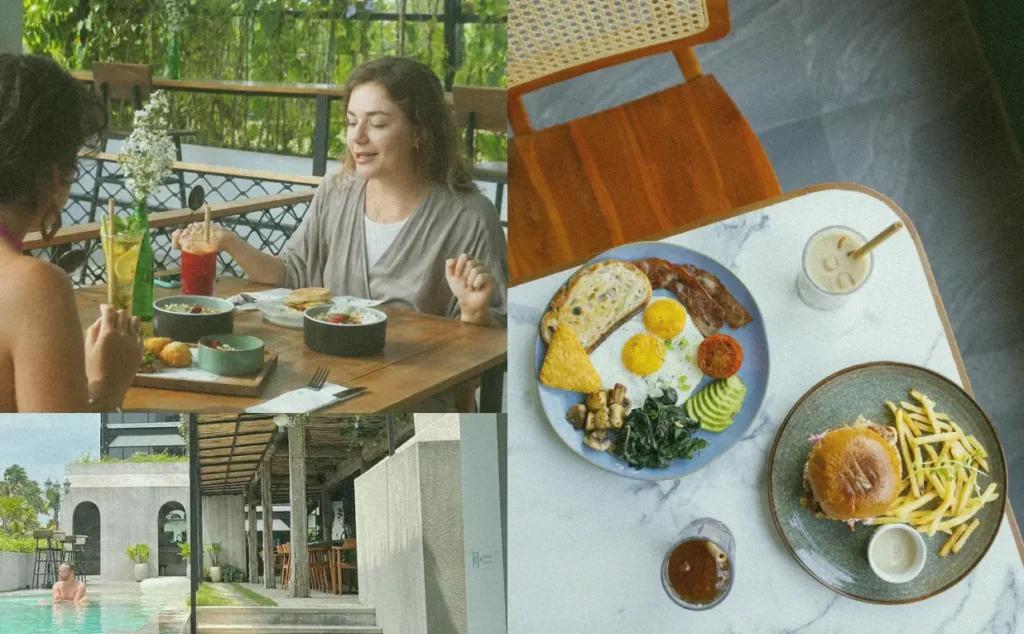
AT 06 in Canggu is where I finally found my rhythm. The coworking space operates on a frictionless, walk-in access model. There are no contracts and no advance bookings required. If I spend at least 150,000 IDR on food and drinks at the restaurant, my desk for the day is included. That is roughly the price of a Flat White (30,000 IDR), a Sticky Ginger Tempeh bowl (60,000 IDR), and a Stay Cooler mocktail (45,000 IDR), which is basically my normal lunch anyway.
If you prefer a structured pass, pricing is straightforward. Daily passes run 100,000 IDR, weekly is 500,000 IDR, and monthly is 1,800,000 IDR. Every pass includes high-speed WiFi, second floor indoor access, and a 10% discount on food and beverages. Weekly and monthly passes add dedicated Skype room access and meeting room hours.
The WiFi is fast and stable. The seating is designed for extended sessions. And because AT 06 integrates a full restaurant, gym, recovery facilities, and community events under one roof, I never have to pack up and relocate when my needs change throughout the day. I can go from a focused work session to a proper lunch to a quick gym session without ever leaving the building. For someone who hates the daily “where do I go next?” decision fatigue, this was transformative.
My Digital Nomad Tools at a Glance
| Category | Top Tools | Why It Matters |
|---|---|---|
| Communication | Slack, Zoom, Google Meet, Figma | Async-first collaboration across time zones |
| Project Management | Notion, Trello, Asana, Routine | My virtual office, CRM, and second brain |
| Finance | Wise, Revolut, XE, Splitwise, YNAB | Multi-currency management without bank fees |
| Security | VPN, Google Drive, Dropbox, pCloud | Data protection and redundant cloud backup |
| Connectivity | Airalo eSIM, local data plans | Instant connectivity from the moment I landed |
| Local Integration | Gojek, Grab, WhatsApp, Tokopedia | Navigate Bali like a local, not a tourist |
One Last Thing
I spent my first month here scrambling. Bouncing between cafes, forgetting chargers, stressing about exchange rates, losing half my morning to logistics. Once I locked in the stack above and found a workspace that actually fit how I work, everything shifted. I stopped surviving the nomad life and started genuinely enjoying it.
If you are in Canggu, come set up at AT 06. Bring your laptop, order a Flat White, and see how much easier it all feels when your workspace, your meals, and your recovery are all under one roof. I will probably be at one of the upstairs tables, headphones on, deep in my Notion dashboard. Come say hi. I promise I am friendly once I take the headphones off.
They are open every day, 6 AM to 10 PM, and yes, your dog is welcome hihi

See similar topics